
Differentiation and Integration: O Level A Math Survival Guide
A clear, student-friendly guide to help O Level A Math students understand differentiation, integration, common mistakes, and smart revision strategies.
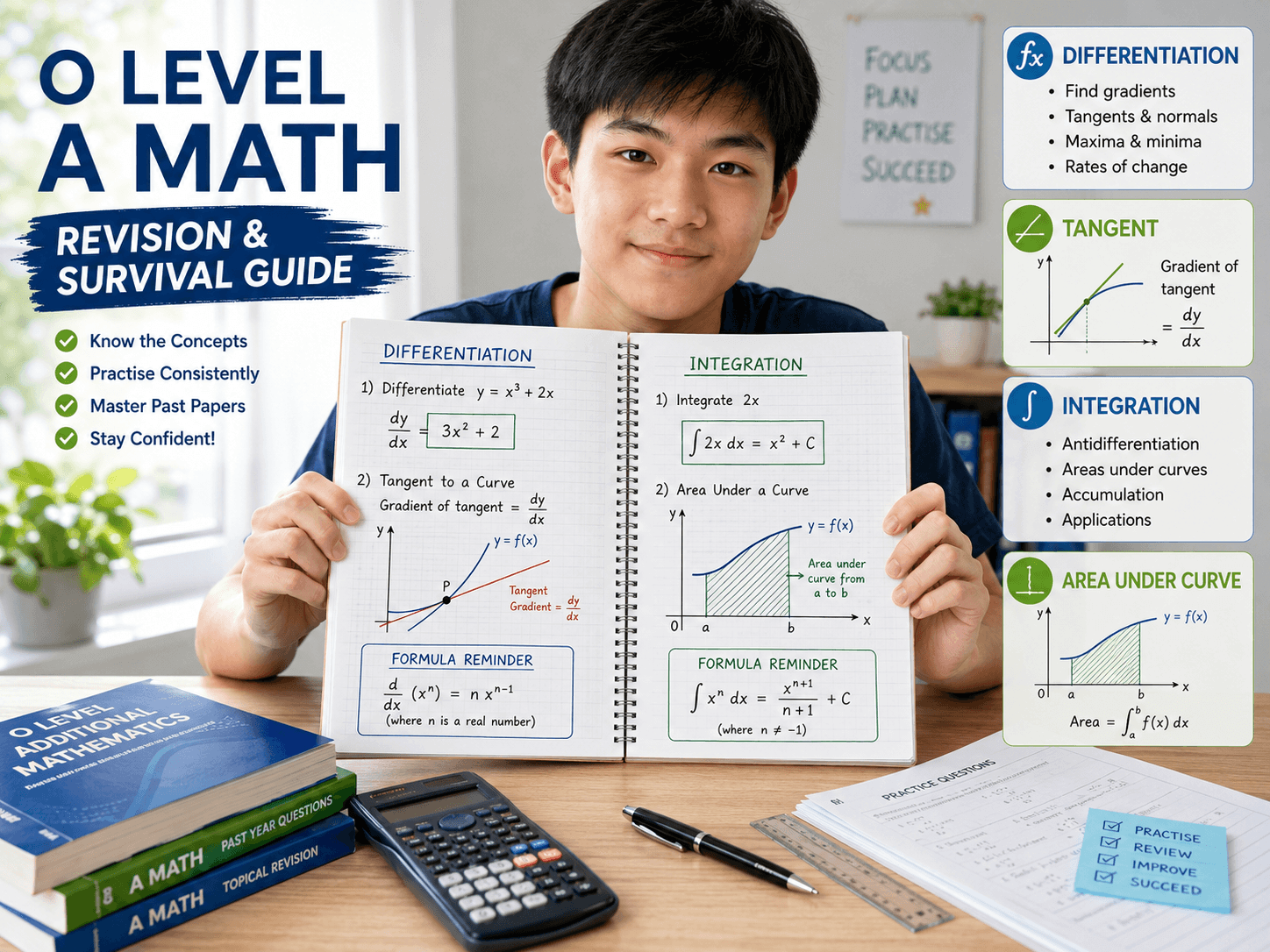
Why Differentiation and Integration Matter in O Level A Math
Calculus is one of the key areas in O Level Additional Mathematics. Students are expected to understand not only the rules, but also how to apply them in exam questions involving curves, gradients, stationary points, increasing and decreasing functions, and areas under graphs.
A student who memorises formulas without understanding the meaning may survive basic questions but struggle with application questions. For example, knowing how to differentiate \(x^2\) is only the beginning. Students must also know what the derivative represents and how it connects to the gradient of a curve.
At MasterMaths O Level A/E Maths Tuition, students are guided through commonly tested A Math techniques with structured coaching and exam-focused practice. This is especially useful for calculus topics because students need clear explanation, proper working, and enough practice across different question types.
What Is Differentiation?
Differentiation is the process of finding the derivative of a function. In O Level A Math, students usually use differentiation to find the gradient of a curve at a point, the equation of a tangent or normal, whether a function is increasing or decreasing, and the maximum or minimum value of a function.
A simple way to think about differentiation is this: it tells us how quickly something is changing. On a graph, the derivative tells us the gradient at a particular point.
Common Uses of Differentiation
- Finding the gradient of a curve
- Finding the equation of a tangent
- Finding the equation of a normal
- Solving maximum and minimum problems
- Determining increasing or decreasing intervals
- Finding stationary points on a curve
Students should not see differentiation as just a set of rules. Each answer should connect back to the question. If the question asks for a gradient, the derivative gives the gradient. If the question asks for a maximum or minimum point, differentiation helps locate where the gradient is zero.
Key Differentiation Skills Students Must Master
To survive O Level differentiation integration questions, students need strong algebra. Many calculus errors are actually algebra errors. Students may know the correct differentiation rule but lose marks because they expand wrongly, simplify incorrectly, or substitute values carelessly.
1
Power Rule
Students must differentiate powers accurately, including negative and fractional powers.
2
Substitution
After differentiating, students often need to substitute values of \(x\) carefully.
3
Tangent
The tangent gradient is found using the derivative at the given point.
4
Normal
The normal gradient is the negative reciprocal of the tangent gradient.
A common exam mistake is confusing tangent and normal gradients. Students should remember that the derivative gives the tangent gradient. If the question asks for the normal, they must convert the tangent gradient into the normal gradient before forming the line equation.
What Is Integration?
Integration is often introduced as the reverse of differentiation. If differentiation breaks a function down to find its rate of change, integration helps rebuild the function or find accumulated quantities such as area under a curve.
In O Level A Math, integration commonly appears in questions involving indefinite integration, definite integration, finding area under a curve, and finding a function when its derivative is given.
Common Uses of Integration
- Finding the original function from a derivative
- Finding constants using given points
- Evaluating definite integrals
- Finding area under a curve
- Finding area between a curve and an axis
- Checking answers by differentiating back
Students often find integration harder because there are more steps to remember. They must integrate correctly, include the constant \(+ C\) when needed, substitute limits carefully, and interpret area questions accurately.
Differentiation vs Integration: What Is the Difference?
Differentiation and integration are closely connected, but they answer different types of questions. Differentiation is usually about gradient, change, and turning points. Integration is usually about reversing differentiation, finding functions, and calculating area.
Differentiation
Used to find gradients, rates of change, tangents, normals, stationary points, and maximum or minimum values.
Integration
Used to reverse differentiation, find original functions, evaluate definite integrals, and calculate areas under curves.
A good way to revise is to practise both together. After differentiating a function, students can integrate the derivative to see whether they can return to the original function. This builds stronger understanding instead of isolated memorisation.
Common Mistakes in Differentiation
Differentiation questions can look simple, but students often lose marks because of small mistakes. These mistakes are avoidable with careful checking habits.
Differentiation Mistakes to Avoid
- Forgetting to reduce the power by 1
- Differentiating constants incorrectly
- Confusing tangent and normal gradients
- Not substituting the correct \(x\)-value
- Forgetting to use the given point in line equations
- Making algebra mistakes before differentiating
Students should train themselves to write each step clearly. For example, after finding \(\frac{dy}{dx}\), write the value of the gradient before moving on to the tangent or normal equation. This prevents confusion and helps secure method marks.
Common Mistakes in Integration
Integration errors are also very common. Students may integrate correctly but lose marks because they forget the constant of integration, substitute limits in the wrong order, or forget that area should be positive.
Integration Mistakes to Avoid
- Forgetting \(+ C\) in indefinite integration
- Dividing by the wrong new power
- Substituting upper and lower limits wrongly
- Leaving area as a negative value
- Not finding the constant when a point is given
- Confusing integration with differentiation rules
For definite integrals, students should slow down when substituting limits. A neat bracket format can reduce careless errors. For area questions, students should check whether the graph lies above or below the axis and whether the final area makes sense.
How to Approach Tangent and Normal Questions
Tangent and normal questions are very common in differentiation. Students should follow a fixed routine so they do not miss steps.
Step-by-Step Approach
- Differentiate the equation to find \(\frac{dy}{dx}\).
- Substitute the given \(x\)-value to find the tangent gradient.
- If the normal is required, find the negative reciprocal gradient.
- Use the given point or find the missing coordinate.
- Substitute into the straight-line equation.
- Check that the final equation is in the required form.
This routine helps students avoid one of the most common A Math mistakes: using the tangent gradient when the question asks for the normal.
How to Approach Maximum and Minimum Questions
Maximum and minimum questions test whether students understand that stationary points occur when the gradient is zero. In many O Level A Math questions, students must form an expression, differentiate it, set the derivative equal to zero, and solve.
These questions often appear in real-world contexts involving area, volume, cost, or distance. Students may find them difficult because they combine algebra, modelling, and differentiation in one question.
Max-Min Question Strategy
- Identify the quantity to maximise or minimise
- Form an expression using one variable
- Differentiate the expression
- Set the derivative equal to zero
- Solve for the unknown value
- Check that the answer fits the question context
Students should also pay attention to units. If the question involves area or volume, the final answer must include the correct unit.
How to Approach Area Under Curve Questions
Area under curve questions usually require integration. Students must identify the correct limits and integrate the correct expression. If the curve crosses the x-axis, the area may need to be split into separate parts.
A common mistake is assuming that the value of an integral is always the required area. If the curve is below the x-axis, the integral may be negative, but area should be positive.
Area Question Checklist
- Sketch or visualise the graph if needed
- Identify the upper and lower limits
- Check whether the curve is above or below the axis
- Split the area if the curve crosses the axis
- Use integration carefully
- Give the final area as a positive value
How to Revise O Level Differentiation Integration Effectively
Students should not revise calculus by reading notes only. Differentiation and integration require active practice. The best revision plan includes formula recall, worked examples, targeted practice, mistake review, and timed questions.
Start with basic techniques before moving into application questions. For example, students should first be confident with differentiating and integrating powers before attempting tangents, normals, max-min problems, and area questions.
1
Learn Rules
Know the basic differentiation and integration rules well.
2
Practise Basics
Build accuracy with direct questions before application questions.
3
Apply Methods
Practise tangents, normals, max-min, and area questions.
4
Review Errors
Record repeated mistakes and redo them after a few days.
How MasterMaths Supports O Level A Math Students
MasterMaths supports students taking O Level A Math and E Math with structured coaching, guided practice, and exam-focused techniques. For calculus topics, students need more than formula memorisation. They need to understand why each method works and how to apply it in different question formats.
Parents and students can explore the MasterMaths O Level Maths Tuition Singapore programme for support in A Math and E Math. Students who want to understand the broader difference between the two subjects can also read the A Math vs E Math guide.
For more learning articles, revision tips, and exam strategies, visit the MasterMaths Blog.
Final Survival Tips for A Math Calculus
The key to surviving O Level differentiation integration topics is consistency. Students should practise a little every week instead of waiting until the exam period. Calculus becomes easier when the rules feel familiar and the question types become recognisable.
Students should also focus on clear working. Many A Math marks come from method, not just the final answer. A neat solution helps students check their own work and makes it easier for teachers to award method marks.
Most importantly, students should not panic when they see calculus questions. Read the question carefully, identify whether it is asking about gradient, line equation, maximum or minimum, reverse differentiation, or area, then choose the right method step by step.
Conclusion
O Level differentiation integration topics can feel challenging at first, but they become manageable with clear concepts, regular practice, and a structured revision plan. Differentiation helps students understand gradients and change, while integration helps students reverse differentiation and find areas.
Students who master the basics, avoid common mistakes, and practise application questions consistently will be better prepared for O Level A Math.
Help Your Child Build Confidence in O Level A Math
Let your child experience clear, structured A Math coaching before committing. Book a free trial class and see how MasterMaths can support differentiation, integration, and O Level exam preparation.