
A Math vs E Math: What’s the Difference?
Understand the key differences between A Math and E Math, including topics, difficulty level, exam focus, and how parents can support their child’s O Level Maths journey.
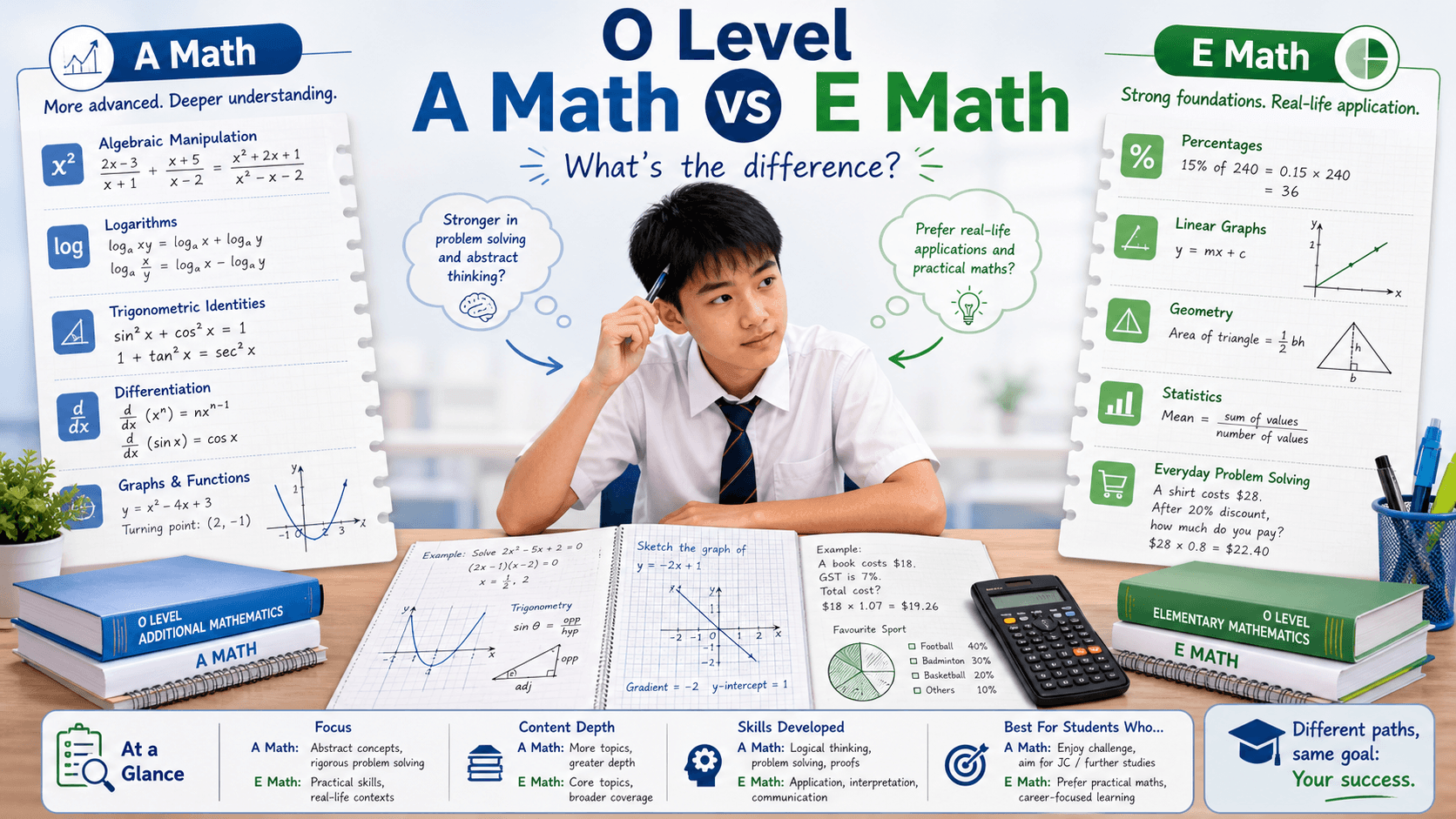
Many Secondary students and parents often ask the same question: what is the real difference between A Math vs E Math? Both subjects are important at O Level, but they test different skills, require different types of thinking, and can affect a student’s future subject choices.
In Singapore, E Math usually refers to Elementary Mathematics, while A Math refers to Additional Mathematics. E Math builds broad mathematical foundations needed for everyday problem-solving and exam applications. A Math goes deeper into algebra, functions, trigonometry, and calculus, making it more abstract and demanding.
If your child is deciding whether to take A Math, struggling with both subjects, or preparing for O Level, this guide will help you understand the key differences clearly.
Quick Comparison: A Math vs E Math
E Math
Broader, more practical, and focused on essential O Level Mathematics skills such as algebra, geometry, statistics, probability, graphs, and measurement.
A Math
Deeper, more abstract, and focused on advanced topics such as functions, logarithms, trigonometry, differentiation, and integration.
What Is E Math?
E Math, or Elementary Mathematics, is the core mathematics subject for O Level students. It covers a wide range of practical and foundational topics such as algebra, geometry, measurement, statistics, probability, graphs, and numbers.
According to the official SEAB O Level Mathematics syllabus, the content is organised into three main strands: Number and Algebra, Geometry and Measurement, and Statistics and Probability.
This means E Math tests whether students can apply mathematical ideas accurately in familiar and unfamiliar contexts. Students need to understand concepts, show clear working, interpret questions carefully, and avoid careless mistakes.
Common E Math Topics
- Numbers and standard form
- Algebraic manipulation
- Linear equations and inequalities
- Graphs and functions
- Geometry and angle properties
- Trigonometry basics
- Mensuration
- Statistics and probability
- Vectors and matrices, where applicable
For students who need structured support, the MasterMaths O Level E Maths Tuition programme helps students build confidence through concept-focused lessons, exam strategies, and expert coaching.
What Is A Math?
A Math, or Additional Mathematics, is a more advanced O Level Mathematics subject. It assumes that students already have a strong foundation in E Math. The official SEAB Additional Mathematics syllabus states that A Math assumes knowledge of O Level Mathematics and is designed for students with aptitude and interest in Mathematics.
A Math is especially useful for students who may want to pursue subjects such as H2 Mathematics, engineering, computing, physics, economics, or other math-related pathways in future.
Common A Math Topics
- Quadratic functions
- Equations and inequalities
- Surds, indices, and logarithms
- Polynomials and partial fractions
- Binomial expansion
- Trigonometric identities and equations
- Coordinate geometry
- Differentiation
- Integration
- Applications of calculus
Compared with E Math, A Math requires stronger algebraic manipulation, deeper reasoning, and more comfort with abstract concepts. Students must not only know formulas, but also understand when and how to apply them.
For students taking both A Math and E Math, the MasterMaths O Level A/E Maths Tuition programme supports students with commonly tested O Level A/E Maths techniques, structured coaching, and exam-focused practice.
A Math vs E Math: Main Differences
The biggest difference in A Math vs E Math is the level of abstraction. E Math is broader and more practical, while A Math is deeper and more algebra-heavy.
Breadth vs Depth
E Math covers many areas. A Math focuses more deeply on selected advanced topics like algebra, trigonometry, functions, and calculus.
Algebra Skills
A Math requires stronger algebraic manipulation and multi-step working compared with E Math.
Question Style
E Math often includes more real-world contexts, while A Math can be more abstract and technique-based.
Future Pathways
A Math can support students who plan to pursue advanced Mathematics, Science, Engineering, Computing, or related fields.
Is A Math Harder Than E Math?
For most students, yes, A Math feels harder than E Math. This is because A Math requires faster algebraic thinking, stronger conceptual understanding, and more independent problem-solving.
However, this does not mean E Math is easy. Many students lose marks in E Math because of careless mistakes, weak foundations, poor time management, or incomplete working.
The best way to think about it is simple: E Math builds the foundation, while A Math stretches students into advanced mathematical thinking.
Should My Child Take A Math?
Your child may be suitable for A Math if they are comfortable with algebra, enjoy problem-solving, and are willing to practise consistently. A Math rewards students who are patient, precise, and willing to work through multi-step solutions.
However, if your child is already struggling with E Math, it may be better to strengthen E Math foundations first before taking on A Math confidently. A weak E Math foundation can make A Math feel overwhelming very quickly.
Questions Parents Can Ask
- Does my child understand algebra well?
- Does my child enjoy solving challenging Maths questions?
- Can my child manage the extra workload?
- Does my child need A Math for future subject choices?
- Is my child willing to revise consistently?
If the answer is mostly yes, A Math can be a useful subject. If the answer is uncertain, your child may benefit from guided support before deciding or before the workload becomes too heavy.
How to Study for A Math and E Math Effectively
How to Study for E Math
To do well in E Math, students should focus on understanding core concepts, practising different question types, and reducing careless mistakes. Since E Math covers many topics, consistent revision is important.
Students should create a mistake journal and record errors such as wrong units, copied numbers, formula mistakes, or misunderstood questions. This helps them avoid repeating the same mistakes during school exams and O Level.
How to Study for A Math
For A Math, students need to practise step-by-step algebraic working. Memorising formulas alone is not enough. They must understand how ideas connect across topics.
The best A Math revision method is to practise consistently, review worked examples carefully, and redo difficult questions after a few days. This builds long-term confidence and prevents students from forgetting key techniques.
How MasterMaths Supports A Math and E Math Students
At MasterMaths, students receive structured support for both E Math and A Math. The lessons are designed to help students understand concepts clearly, practise exam-style questions, and build confidence step by step.
MasterMaths supports O Level students through small-group coaching, online and in-centre options, and exam-focused guidance. Parents can also explore more learning articles through the MasterMaths Blog.
Whether your child needs help with E Math foundations or A Math advanced topics, the right support can make a big difference. Students who learn the correct techniques early are more likely to manage school exams confidently and prepare well for O Level.
Conclusion
Understanding A Math vs E Math helps parents and students make better decisions. E Math is the essential foundation for O Level Mathematics, while A Math is a more advanced subject that prepares students for higher-level mathematical thinking.
Both subjects require consistent practice, clear concepts, and strong exam skills. The key is not to compare which subject is “better”, but to understand what each subject demands and how your child can prepare properly.
If your child is taking O Level E Math, A Math, or both, MasterMaths can help them build confidence with structured coaching and clear explanations.
Help Your Child Build Confidence in O Level Maths
Want to know whether your child needs support for A Math, E Math, or both? Let your child experience clear, step-by-step Maths coaching with MasterMaths.