
Secondary 1 Maths: How to Avoid the Common Pitfalls
A practical guide for parents and Sec 1 students to handle the jump from Primary Maths to Secondary Maths with stronger confidence and better study habits.
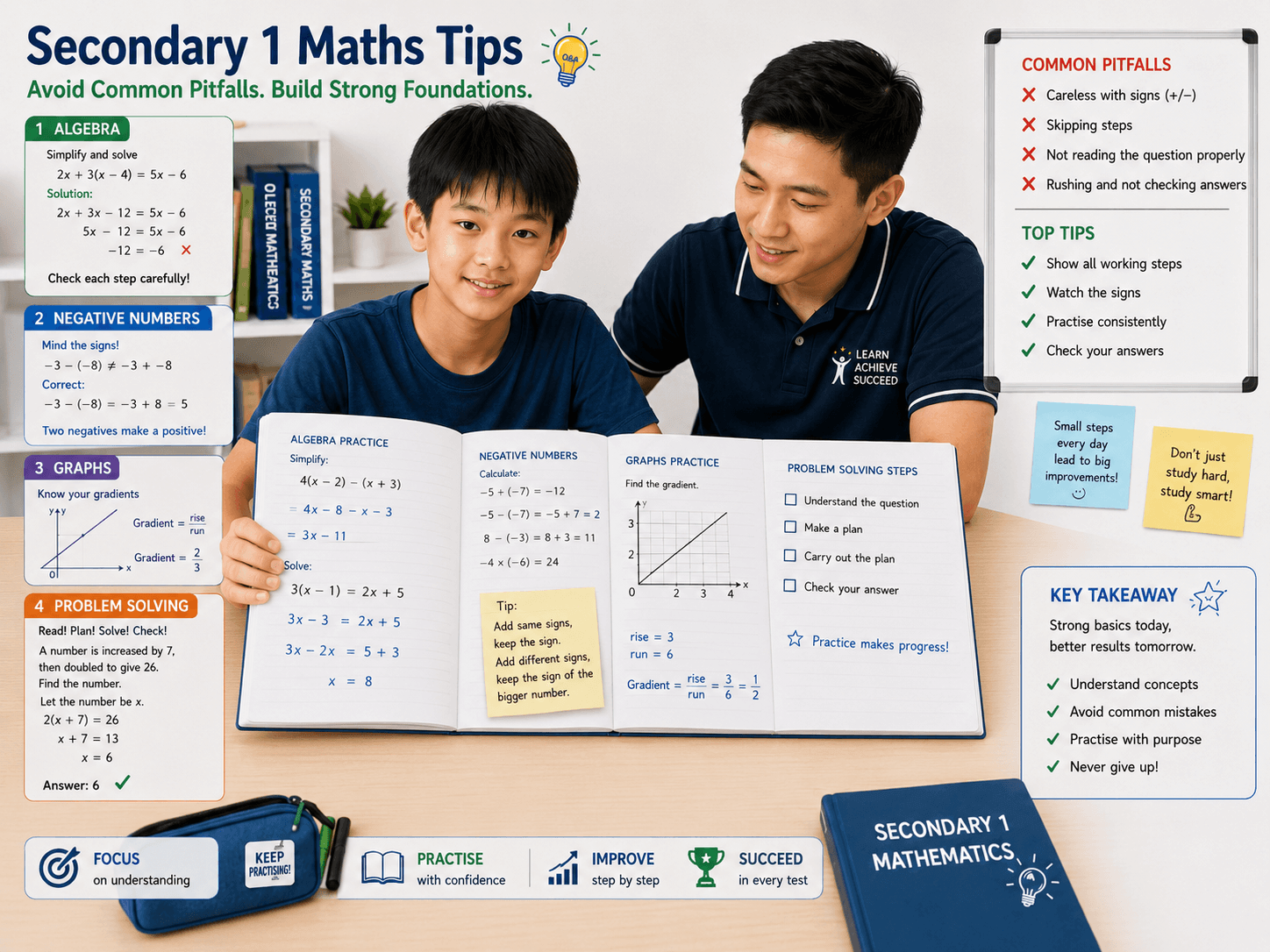
Why Secondary 1 Maths Feels Different
Secondary 1 Maths is not simply “harder Primary Maths”. It introduces students to a new way of thinking. There is more algebra, more abstract reasoning, more negative numbers, and more emphasis on explaining steps clearly.
In Primary school, many students can rely on familiar question types and repeated practice. In Secondary school, questions often require students to connect concepts, choose suitable methods, and work through multi-step solutions.
MasterMaths supports Secondary Maths students, including Sec 1 Maths, through structured weekly coaching and guided practice. Parents can also explore more learning resources through the MasterMaths Blog.
Pitfall 1: Weak Algebra Foundations
Algebra is one of the biggest changes in Secondary 1 Maths. Students are introduced to letters, expressions, equations, expansion, factorisation basics, and substitution. Many students struggle because they treat algebra like a memorisation topic instead of a language of Maths.
A common mistake is not understanding what a variable represents. For example, students may be able to calculate with numbers, but feel confused when the question uses \(x\), \(y\), or \(a\). This can lead to errors in simplifying expressions or solving equations.
How to Avoid This Pitfall
- Understand what variables represent
- Practise simplifying expressions step by step
- Check signs carefully when moving terms
- Show working clearly for each equation
- Revise basic operations with negative numbers
- Redo algebra mistakes until the method feels natural
Pitfall 2: Careless Mistakes with Negative Numbers
Negative numbers appear frequently in Secondary 1 Maths. They may appear in directed numbers, algebra, coordinate geometry, graphs, and equations. Students who are careless with signs can lose many marks even when they understand the main method.
For example, a student may know how to solve an equation but make a sign error when subtracting a negative number. These mistakes can affect the rest of the solution and make the final answer wrong.
Checking Habits for Negative Numbers
- Circle negative signs when copying questions
- Use brackets when substituting negative values
- Check every line before moving to the next step
- Revise integer rules regularly
- Be extra careful with subtraction of negatives
- Avoid skipping mental steps too quickly
Pitfall 3: Not Showing Clear Working
In Secondary Maths, final answers are not enough. Students must show clear working to earn method marks and to help teachers understand their thinking. This becomes especially important as questions become longer.
Some Sec 1 students try to do too many steps mentally. While this may seem faster, it often leads to missing steps, careless errors, and confusion during checking.
Good Working Should Include:
- Clear equation setup
- One major step per line
- Correct use of equal signs
- Units where required
- Labels for diagrams, graphs, and tables
- Final answer written clearly
Clear working also helps students revise better. When they review corrections, they can see exactly where the mistake happened.
Pitfall 4: Forgetting Primary Maths Foundations
Secondary 1 Maths still depends heavily on Primary Maths foundations. Fractions, decimals, percentages, ratio, area, volume, and problem-solving skills continue to appear in new forms.
Students who enter Secondary 1 with weak foundations may find it harder to keep up. For example, algebraic fractions can become difficult if a student is already weak in normal fractions.
1
Fractions
Revise addition, subtraction, multiplication, division, and simplification of fractions.
2
Percentages
Practise percentage increase, decrease, discount, GST-style questions, and comparison.
3
Ratio
Strengthen units and parts, comparison, and ratio word problems.
4
Geometry
Revise area, perimeter, volume, angles, and basic diagram interpretation.
Pitfall 5: Studying Only Before Tests
One of the most important secondary 1 maths tips Singapore parents should know is this: students should not wait until the week before a test to revise. Secondary Maths requires regular practice because topics build on one another.
A student who ignores algebra for several weeks may struggle when equations appear again in graphs, word problems, or later chapters. Consistent short revision sessions are more effective than last-minute cramming.
Simple Weekly Revision Plan
- Review class notes after each lesson
- Redo 3 to 5 mistakes from the week
- Practise one weak topic every weekend
- Keep a small formula and mistake notebook
- Ask questions early instead of waiting
- Complete corrections before starting new practice
Pitfall 6: Not Asking for Help Early
Some students stay quiet when they do not understand a topic. They may feel shy, afraid of looking weak, or assume they can catch up later. Unfortunately, small gaps can quickly grow into bigger problems.
Parents can help by checking in gently. Instead of asking only “How many marks did you get?”, ask questions like “Which topic feels most confusing?” or “Which correction do you still not understand?”
At MasterMaths, students receive structured Maths coaching with in-centre and online options. MasterMaths also provides access to online tutor support, which helps students ask questions and clear doubts beyond the lesson itself.
How Parents Can Support Sec 1 Maths at Home
Parents do not need to teach every Secondary 1 topic. What matters more is helping students build routine, confidence, and accountability.
Set a fixed weekly revision time, encourage students to complete corrections properly, and help them organise worksheets by topic. If your child is struggling, avoid blaming them for being careless. Instead, find out whether the issue is concept understanding, exam technique, time management, or confidence.
For students who need more structured support, parents can explore Secondary and O Level pathways through MasterMaths O Level Maths Tuition Singapore. Building the right habits from Sec 1 can make the later O Level years less stressful.
Final Thoughts: Start Strong in Secondary 1 Maths
Secondary 1 is an important year because it sets the foundation for upper secondary Maths. Students who build good habits early are more likely to handle future topics with confidence.
The most common pitfalls are weak algebra foundations, careless sign errors, unclear working, forgotten Primary Maths concepts, last-minute revision, and not asking for help early.
With the right secondary 1 maths tips Singapore students can build stronger foundations, avoid repeated mistakes, and become more confident problem solvers.
Continue Learning with MasterMaths
MasterMaths supports students from Primary to Secondary levels, including PSLE, N Level, and O Level Maths. Students are guided through structured practice, concept explanation, and exam-focused preparation.
Parents can explore more study guides, Maths tips, and exam preparation articles through the MasterMaths Blog.
Help Your Child Build a Strong Sec 1 Maths Foundation
Let your child experience clear, structured Maths coaching before committing. Book a free trial class and see how MasterMaths can support your child’s Secondary Maths journey.