
Top 5 PSLE Maths Heuristics Every P6 Student Must Know
Help your child solve challenging PSLE Maths heuristics problem sums with clearer thinking, stronger strategies, and better exam confidence.
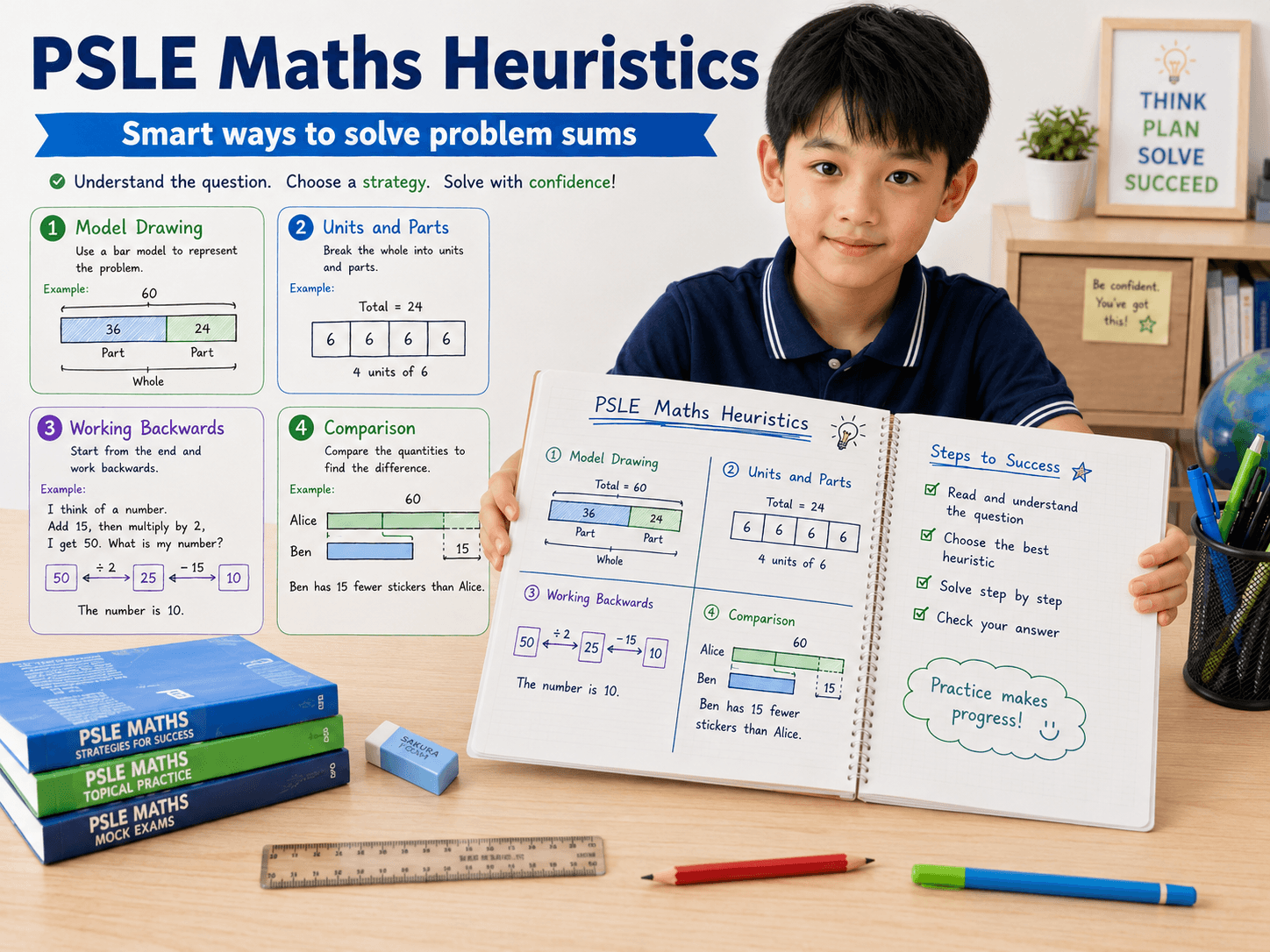
Why PSLE Maths Heuristics Matter
PSLE Maths is not only about calculation. It also tests reasoning, comparison, pattern recognition, and the ability to select the right strategy under exam pressure. A student may understand the topic but still lose marks because they do not know how to start the question.
Good heuristics give students a thinking framework. For example, when a question involves changing quantities, the student may consider a before-change-after table. When a question involves comparison, the student may use model drawing or units and parts. When a question gives the final result and asks for the original number, working backwards may be the best method.
At MasterMaths PSLE Maths Tuition Singapore, students are guided to build stronger foundations, problem-solving skills, and exam confidence through structured coaching and PSLE-focused practice.
Heuristic 1: Model Drawing
Model drawing is one of the most important PSLE maths heuristics because it helps students see relationships visually. Instead of trying to hold all the information in their head, students draw bars to represent quantities.
This method is especially useful for questions involving comparison, fractions, ratios, remainder, excess and shortage, and before-and-after changes. A good model helps students understand what is equal, what is different, and what needs to be found.
When to Use Model Drawing
- Comparison questions
- Fraction problem sums
- Ratio problem sums
- Remainder questions
- Before-and-after questions
- Questions with two or more people/items
A common mistake students make is drawing the model without thinking carefully. The model should match the story in the question. Students should label each bar clearly and show what each part represents.
Heuristic 2: Units and Parts
Units and parts is a powerful method for ratio, fraction, and percentage questions. Students use equal parts to represent quantities and then find the value of one unit before solving the rest of the question.
For example, if two quantities are in the ratio \(3:5\), the total number of parts is \(3 + 5 = 8\). If the total amount is known, students can find the value of one part and then calculate each quantity.
Why Units and Parts Help
- It organises ratio information clearly
- It helps students compare quantities
- It reduces random guessing
- It supports fraction and percentage questions
- It helps students find missing values step by step
The key is to identify what one unit represents. Once students know the value of one unit, the question usually becomes easier to solve. This is why units and parts is one of the most practical PSLE maths heuristics for P6 students.
Heuristic 3: Before-Change-After
Before-change-after is useful when a question describes a situation that changes over time. For example, someone gives away items, receives more items, spends money, saves money, or transfers something to another person.
Many students make mistakes in these questions because they mix up the original amount, the change, and the final amount. A before-change-after table helps them organise the information clearly.
How Students Should Set It Up
- Write down the starting amount under “Before”.
- Record what is added, removed, shared, or transferred under “Change”.
- Write the final amount or final ratio under “After”.
- Compare the unchanged quantity if there is one.
- Use the final relationship to work back to the original amount.
This method is especially useful for PSLE problem sums involving ratio changes, money changes, and transfer questions. MasterMaths’ PSLE page also highlights heuristics such as Before-Change-After, Remainder, and Equal Concepts as part of problem-solving support for non-routine questions.
Heuristic 4: Working Backwards
Working backwards is useful when the question gives the final result and asks for the original amount. Instead of solving from the beginning, students reverse the steps from the end.
For example, if a question says a student spent half of his money, then spent another amount, and finally had $20 left, students may need to reverse each step to find the original amount.
Common Clues for Working Backwards
- The final amount is given
- The starting amount is unknown
- The question involves repeated changes
- Words like “left”, “remaining”, or “in the end” appear
- The answer asks for the original amount
To avoid mistakes, students should reverse operations carefully. Addition becomes subtraction, subtraction becomes addition, multiplication becomes division, and division becomes multiplication. Each reversed step should be written clearly.
Heuristic 5: Systematic Listing
Systematic listing is useful when students need to find possible combinations, arrangements, or cases. Instead of listing randomly, students organise their working so they do not miss any possible answers.
This method is commonly used in questions involving combinations, number patterns, logic, repeated choices, and “how many ways” questions. It trains students to think carefully and check their answers.
How to List Systematically
- Start with the smallest or largest possible value
- Change only one variable at a time
- Use a table to organise cases
- Check that no case is repeated
- Check that no possible case is missed
Systematic listing may look simple, but it is very important in PSLE Maths. A random list can easily lead to missing answers. A systematic list shows clear thinking and improves accuracy.
How to Know Which Heuristic to Use
One of the biggest challenges students face is not learning the methods, but knowing when to use each method. A student may know model drawing, working backwards, and ratio units, but still feel unsure during an exam.
The solution is to train students to recognise question clues. They should read the question carefully, underline key information, and ask what type of relationship is involved.
1
Compare
Use model drawing when the question compares two or more quantities.
2
Ratio
Use units and parts when the question gives ratio, fraction, or percentage relationships.
3
Change
Use before-change-after when quantities are added, removed, transferred, or changed.
4
Final Result
Use working backwards when the ending amount is known but the original amount is unknown.
Common Mistakes Students Make with Heuristics
Learning PSLE maths heuristics is helpful, but students must also avoid common mistakes. Some students memorise a method without understanding why it works. Others jump into solving too quickly without reading the question properly.
Mistakes to Avoid
- Using model drawing without labels
- Mixing up before and after quantities
- Forgetting to find the value of one unit
- Listing cases randomly
- Skipping working steps
- Not checking if the answer makes sense
Students should practise with feedback. This helps them understand whether they selected the right heuristic, applied it correctly, and presented their working clearly.
How Parents Can Help at Home
Parents do not need to teach every PSLE Maths method in detail. Instead, they can help by encouraging good problem-solving habits. When a child gets stuck, avoid giving the answer immediately. Ask guiding questions such as: “What is changing?”, “Can you draw it?”, or “What does one unit represent?”
Parents can also help by reviewing mistakes with their child. A mistake journal is useful because it helps students track repeated errors and revise them before the next test.
For more structured practice, students can explore PSLE problem sums support, where problem-solving techniques and common PSLE-style question types are taught step by step.
Final Thoughts: Heuristics Build Confidence
The top 5 PSLE maths heuristics every P6 student should know are model drawing, units and parts, before-change-after, working backwards, and systematic listing. These strategies help students approach difficult questions with a clearer plan.
The goal is not to memorise methods blindly. The goal is to understand the question, choose the right strategy, and solve step by step with confidence.
Students who practise heuristics consistently are more likely to stay calm during exams, avoid careless mistakes, and improve their problem-solving accuracy.
Continue Learning with MasterMaths
MasterMaths supports students with PSLE Maths, problem sums, and structured exam preparation. Parents can also explore more learning articles through the MasterMaths Blog.
With clear guidance, consistent practice, and the right problem-solving strategies, students can become more confident in handling PSLE Maths questions.
Help Your Child Master PSLE Maths Heuristics
Let your child experience clear, step-by-step PSLE Maths coaching with MasterMaths and learn how to apply the right heuristic for challenging problem sums.