
Improve PSLE Maths Score by 2 ALs in 6 Months
A practical 6-month PSLE Maths revision plan to help your child strengthen concepts, reduce careless mistakes, and move closer to their target Achievement Level.
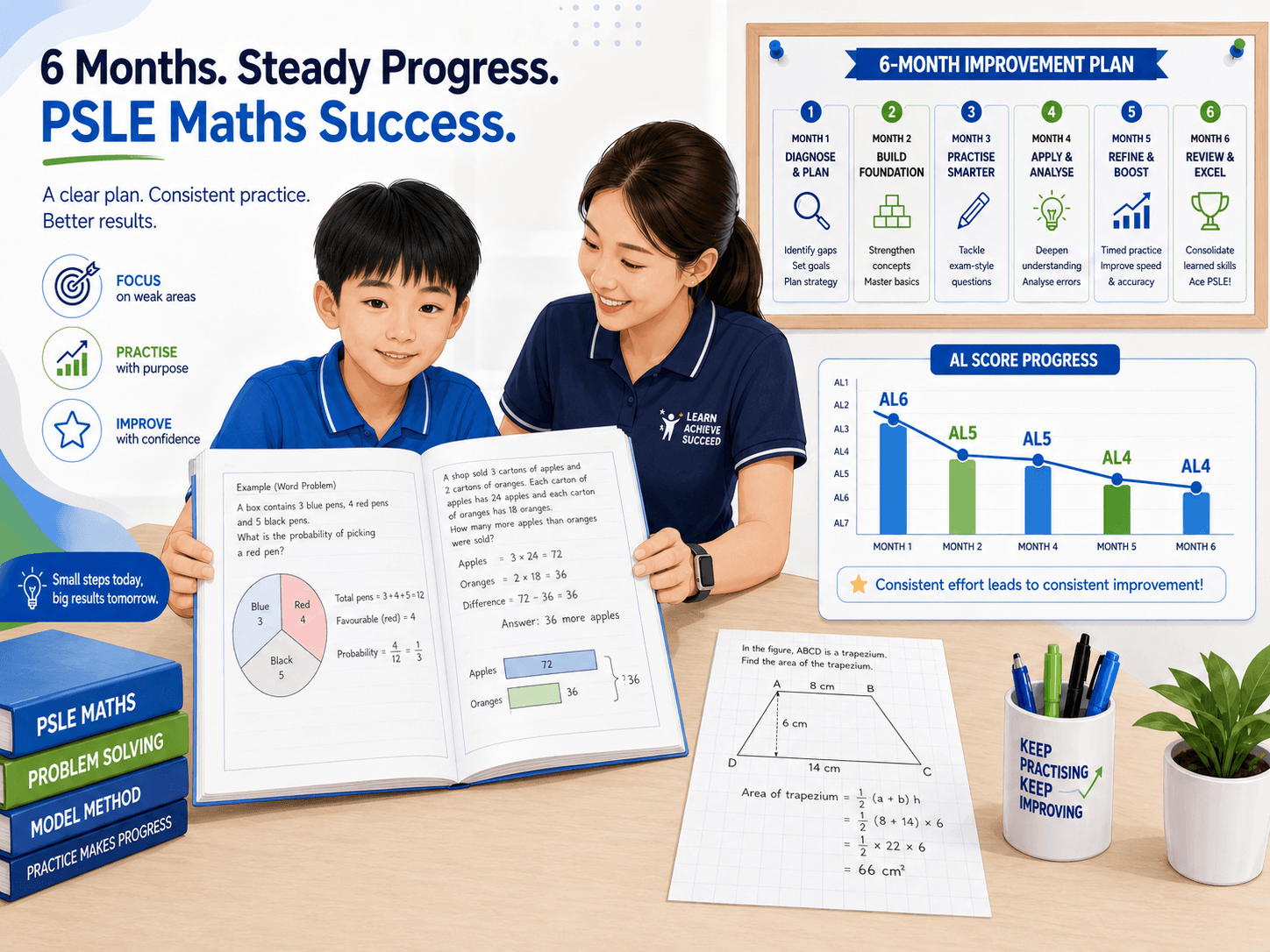
Every parent wants to see their child improve PSLE maths score before the final examination. The good news is that a 2 AL improvement in 6 months is possible when revision is structured, consistent, and focused on the right areas.
However, improvement does not come from simply doing more worksheets. Many Primary 6 students spend hours practising, but their marks remain the same because they repeat the same mistakes, avoid difficult problem sums, or revise without a clear plan.
In this guide, we will share a practical 6-month strategy to help students strengthen concepts, reduce careless mistakes, improve problem-solving confidence, and move closer to their target Achievement Level. Under Singapore’s PSLE Achievement Level system, each subject is scored from AL1 to AL8, with AL1 being the strongest band. For example, AL1 is awarded for scores of 90 and above, while AL2 is for 85 to 89. MOE’s PSLE score calculator explains the AL scoring bands clearly.
Why 6 Months Is Enough Time to Improve PSLE Maths Score
Six months may sound short, but it is actually a powerful revision window if used properly. By this stage, most students have already learnt the main PSLE Maths topics. The focus should no longer be only on learning new content, but on closing gaps, mastering exam techniques, and applying concepts accurately under timed conditions.
At MasterMaths PSLE Maths Tuition Singapore, students are guided through commonly tested PSLE techniques, weekly 90-minute coaching, and structured revision support. This matters because students often need more than answers. They need to understand why a method works, when to use it, and how to avoid common traps in exam questions.
To improve PSLE maths score by 2 ALs, students need a clear system. For example, a child currently scoring around AL5 may need to build stronger foundations and reduce major concept errors. A child already near AL3 may need to improve accuracy, speed, and higher-order problem sums to push towards AL2 or AL1.
Step 1: Identify the Current AL Gap
Before starting any revision plan, parents and students should identify the child’s current score range. A vague goal like “do better in Maths” is not enough. A better goal would be: “Move from AL5 to AL3 by improving problem sums and reducing careless mistakes.”
Look for Repeated Mistake Patterns
- Weakness in fractions, ratio, percentage, or speed
- Difficulty understanding multi-step problem sums
- Careless mistakes in calculation or units
- Incomplete working or poor presentation
- Running out of time during Paper 2
This helps students revise with purpose. Instead of doing random questions every day, they can focus on the exact skills that will help improve PSLE maths score most effectively.
Step 2: Rebuild Core Concepts First
Many PSLE Maths mistakes happen because the foundation is weak. Students may know how to follow a worked example, but they struggle when the question changes slightly. This is especially common in topics like fractions, ratio, percentage, geometry, volume, and speed.
For the first 6 to 8 weeks, students should focus on rebuilding core concepts. This includes revisiting each major topic, correcting misconceptions, and practising simple-to-medium questions before moving to challenging problem sums.
Important PSLE Maths Topics to Strengthen
- Fractions and mixed numbers
- Decimals and percentages
- Ratio and proportion
- Area, perimeter, and volume
- Angles and geometry
- Speed, distance, and time
- Average and data questions
- Problem sums involving models and comparison
Students should not rush this stage. Strong concepts make later revision easier. When students understand the “why” behind each method, they become more confident when facing unfamiliar PSLE-style questions.
Step 3: Master PSLE Problem-Sum Strategies
Problem sums are often the biggest reason students struggle to improve PSLE maths score. These questions test more than calculation. They test reading, interpretation, comparison, logical thinking, and method selection.
Students should learn common PSLE problem-solving strategies such as model drawing, units and parts, before-and-after comparison, working backwards, assumption method, and systematic listing. These strategies help students break down long questions into smaller, manageable steps.
MasterMaths also offers support for PSLE problem sums, where students practise PSLE-style questions with step-by-step solving techniques and guided coaching. This is useful because many students know the formula but do not know how to start when the question is wordy or unfamiliar.
How to Practise Problem Sums Properly
- What information is given?
- What is the question asking for?
- Which quantities are being compared?
- Can I draw a model or table?
- Is this a before-and-after question?
- Does the answer make sense?
This habit trains students to think before calculating. Over time, they become less dependent on memorised methods and more confident in solving new questions.
Step 4: Create a Weekly 6-Month PSLE Maths Plan
A 6-month plan works best when revision is broken into weekly targets. Parents do not need to overload their child with hours of daily practice. Consistency is more important than quantity.
Month 1 to 2
Focus on weaker topics and basic concepts. Review school notes, redo previous mistakes, and practise topical questions.
Month 3 to 4
Move into challenging Paper 2 questions. Practise model drawing, ratio comparison, percentage change, speed, and multi-step problem sums.
Month 5
Start doing full papers under timed conditions. Build exam stamina and review every mistake carefully after each paper.
Month 6
Focus on accuracy, speed, confidence, and exam strategy. Redo past mistakes and practise selected high-value questions.
Step 5: Reduce Careless Mistakes
Careless mistakes can easily cost students 5 to 10 marks. For students trying to move up by 2 ALs, these marks can make a major difference.
Common careless mistakes include copying numbers wrongly, skipping units, answering in the wrong format, pressing the calculator incorrectly, misreading “more than” and “less than”, or forgetting to check whether the answer is reasonable.
Simple Checking Routine
- Underline key information in the question
- Circle the final answer required
- Check units such as cm, m, kg, litres, and dollars
- Estimate whether the answer is reasonable
- Leave time at the end to check high-mark questions
This simple habit can help improve PSLE maths score because students stop losing marks that they already know how to get.
Step 6: Use the Right Tuition Support
Some students can revise independently, but many Primary 6 students improve faster with structured guidance. A good PSLE Maths programme helps students identify weak areas, learn proper answering techniques, practise exam-style questions, and stay motivated throughout the months leading to PSLE.
MasterMaths supports students from PSLE to O Level, with physical centres and online lesson options. The main MasterMaths website describes the centre as a Singapore Maths tuition centre for PSLE, N Level, and O Level students, with weekly coaching and free trial options available. You can explore the main learning resources and articles through the MasterMaths Blog.
For families planning ahead beyond PSLE, the O Level Maths Tuition Singapore programme also supports students in A Math and E Math techniques as they move into secondary school. This makes the transition smoother for students who want to build long-term confidence in Maths.
How Parents Can Support Their Child at Home
Parents play an important role in helping children improve PSLE maths score. Support does not always mean teaching every question. Sometimes, the best support is helping the child stay consistent, calm, and organised.
Parents can help by setting a fixed revision schedule, checking that mistakes are reviewed, encouraging short but focused practice sessions, and praising effort rather than only results. It is also helpful to avoid comparing the child with classmates or siblings. Every child improves at a different pace.
If the child feels overwhelmed, break revision into smaller goals. For example, instead of saying “complete one full paper today,” try “complete 5 ratio questions and review all mistakes carefully.” Small wins build momentum.
Can Every Student Improve by 2 ALs?
A 2 AL improvement is a realistic goal for many students, but it depends on the starting point, consistency, support, and the child’s willingness to correct mistakes. Students who revise actively, ask questions, and practise with proper feedback usually improve faster than students who only complete worksheets without reflection.
The key is not to wait until the final month. Six months gives enough time to rebuild weak foundations, practise PSLE problem sums, improve time management, and strengthen exam confidence.
Final Thoughts: Start Early, Revise Smart, Stay Consistent
To improve PSLE maths score by 2 ALs in 6 months, students need more than hard work. They need the right plan, the right techniques, and the right support. A strong revision strategy should include foundation repair, targeted problem-sum practice, timed papers, mistake correction, and confidence-building.
With consistent effort, students can move closer to their target AL and enter the PSLE Maths exam with greater confidence.
If your child needs structured guidance, clear explanations, and exam-focused PSLE Maths support, MasterMaths is here to help.
Ready to Help Your Child Improve PSLE Maths Score?
Book a free trial class and let your child experience how MasterMaths teaches PSLE Maths step by step with clear guidance and exam-focused support.