
How to Choose a Maths Tuition Centre in Singapore
A practical guide for parents who want to choose the right Maths tuition centre for their child’s level, learning needs, confidence, and exam goals.
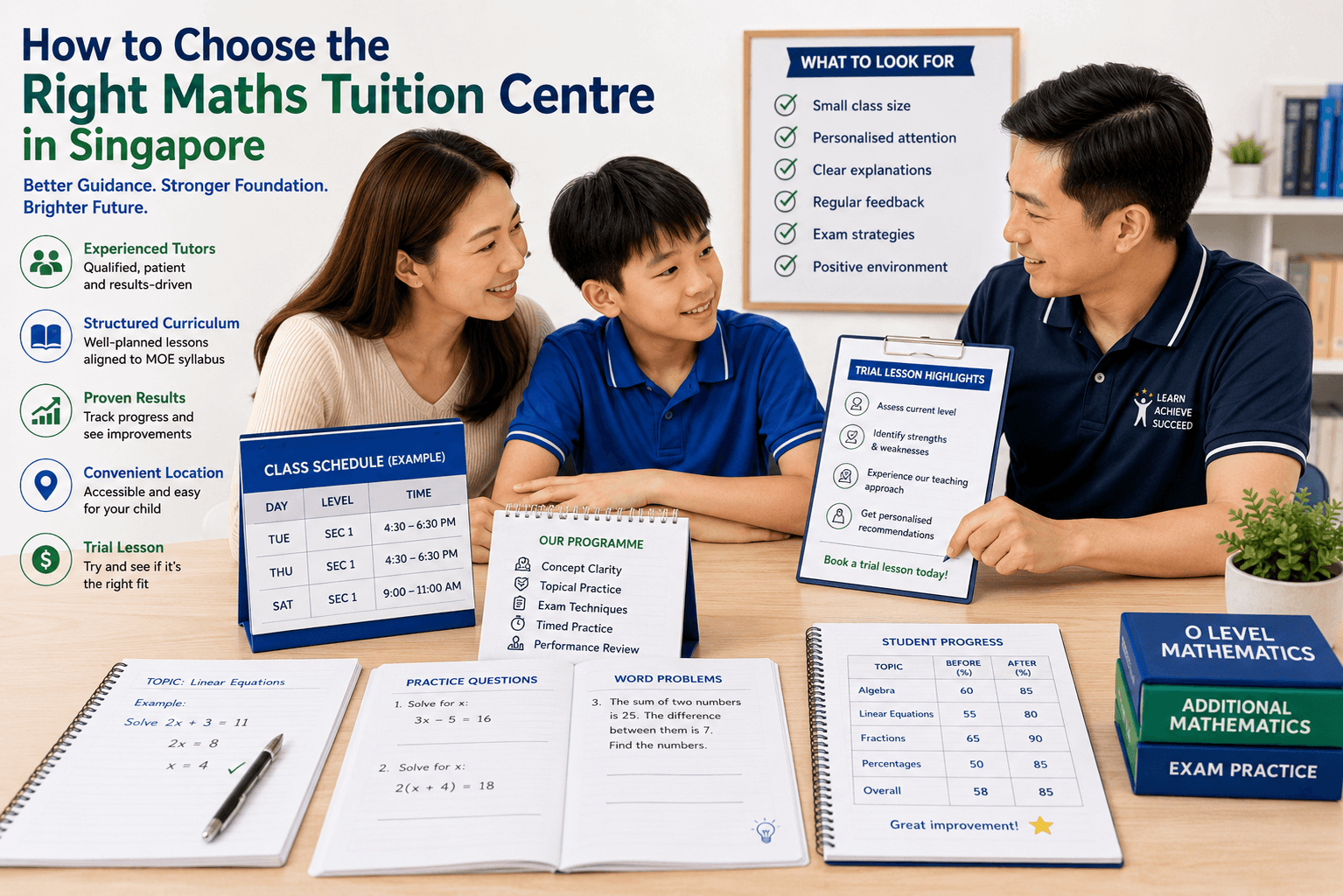
Why Choosing the Right Maths Tuition Centre Matters
Maths is a subject that builds layer by layer. If a child has weak foundations in fractions, ratio, algebra, geometry, or problem sums, future topics can quickly feel more difficult. This is why choosing the right support early can make a meaningful difference.
A good tuition centre helps students identify gaps and fix them step by step. Instead of simply rushing through more practice papers, the centre should teach students how to think, how to present working clearly, and how to avoid common exam mistakes.
At MasterMaths PSLE Maths Tuition Singapore, students receive structured guidance for PSLE Maths concepts, problem sums, and exam preparation. For older students, MasterMaths O Level Maths Tuition Singapore supports both A Math and E Math through exam-focused coaching.
1. Check Whether the Centre Matches Your Child’s Level
The first step is to make sure the tuition centre supports your child’s current level and exam pathway. A Primary 5 student preparing for PSLE needs a different type of support from a Secondary 3 student taking A Math or E Math.
Parents should look for a centre that understands the demands of the Singapore Maths syllabus and has suitable programmes for different stages. This helps ensure that lessons are not too easy, too advanced, or disconnected from school expectations.
Questions to Ask
- Does the centre teach my child’s current level?
- Does it support PSLE, N Level, or O Level preparation?
- Are lessons aligned with school and exam requirements?
- Will my child be grouped with students of a suitable level?
- Does the centre support both weaker and stronger students?
- Is there a clear learning path across the year?
2. Look for Clear Teaching, Not Just More Practice
Practice is important, but practice alone is not enough. If students keep doing questions without understanding their mistakes, they may repeat the same errors again and again.
A strong Maths tuition centre should explain concepts clearly. Students should understand why a method works, when to use it, and how to apply it in different question types.
This is especially important for PSLE problem sums and O Level application questions. Students often lose marks not because they cannot calculate, but because they do not know how to start, what method to choose, or how to organise their working.
Good Teaching Should Help Students:
- Understand concepts instead of memorising blindly
- Break difficult questions into smaller steps
- Recognise common question types
- Present working clearly for method marks
- Review mistakes and avoid repeating them
3. Consider Class Size and Student Attention
Class size can affect how much attention a student receives. In a very large class, some students may feel shy to ask questions or may not receive enough guidance when they are stuck.
Smaller group settings can give students more chances to clarify doubts while still benefiting from peer learning. For many students, this balance works well because they get structure, motivation, and teacher support in the same environment.
When you choose maths tuition centre Singapore options, ask how students are supported during class. A good class should not feel like a lecture where students quietly copy answers without understanding.
4. Review the Curriculum and Lesson Structure
A good tuition centre should have a structured curriculum. This means lessons are planned with clear objectives, topic progression, revision checkpoints, and exam preparation phases.
Without structure, students may only practise random questions. This can create short-term activity but not long-term improvement. Parents should ask whether the centre follows a planned sequence and whether students receive enough topical practice before moving into exam papers.
1
Foundation
Lessons should strengthen key concepts before students attempt harder questions.
2
Application
Students should learn how to apply concepts in different problem types.
3
Revision
Older topics should be revisited so students do not forget them before exams.
4
Exam Skills
Students should practise accuracy, timing, checking habits, and presentation.
5. Ask About Feedback and Progress Tracking
Parents should not be left guessing whether tuition is helping. While improvement may take time, there should be some form of feedback or visibility on the child’s progress.
Useful feedback can include areas of weakness, topics that need revision, common careless mistakes, or whether the child is participating actively in class. This helps parents support revision at home more effectively.
Progress Signals to Look For
- Your child understands corrections better
- Careless mistakes start to reduce
- Working becomes clearer and more organised
- Your child feels more confident in difficult topics
- Test performance becomes more consistent
- Your child knows what to revise next
6. Compare Fees with Value, Not Price Alone
Tuition fees matter, especially for families planning long-term support. However, the cheapest option is not always the best value, and the most expensive option is not always the most effective.
Parents should compare what is included: lesson duration, teaching quality, materials, class size, feedback, revision support, and exam preparation. A transparent fee structure also helps parents plan ahead without unexpected costs.
MasterMaths positions its weekly Maths coaching from $275/month and offers free trial availability for parents who want to experience the teaching style before committing.
7. Consider Location, Schedule, and Online Options
Convenience matters because consistency is important. If travelling to class is too stressful, students may become tired before lessons even begin. Parents should consider whether the centre location, timing, and lesson mode fit the family’s weekly schedule.
Some families prefer in-centre learning because it gives students a focused environment. Others prefer online or hybrid options because it saves travel time. The best option depends on your child’s learning style and your family routine.
MasterMaths has centre options across Singapore and also supports online learning. Parents can check the MasterMaths locations page to explore available centre options.
8. Always Try a Trial Lesson First
A trial lesson is one of the best ways to understand whether a tuition centre is suitable for your child. It allows the student to experience the teaching style, class pace, explanation quality, and learning environment before parents commit.
During or after the trial, ask your child how they felt. Did the explanation make sense? Was the pace manageable? Did they feel comfortable asking questions? Did they leave the class feeling clearer or more confused?
What to Observe During a Trial Lesson
- Is the tutor clear and patient?
- Does the lesson match your child’s level?
- Are students guided step by step?
- Is the class environment encouraging?
- Does your child feel more confident after class?
- Are the next steps clear after the trial?
Why Parents Choose MasterMaths
MasterMaths supports students from Primary to Secondary levels, including PSLE, N Level, and O Level Maths. Its programmes focus on clear explanations, structured practice, and exam confidence.
The centre provides both in-centre and online options, making it easier for families to find a lesson arrangement that suits their schedule. Students can also benefit from a focused Maths environment where they practise with guidance and learn how to correct mistakes properly.
Parents who want to learn more about Maths preparation, study habits, and exam strategies can also explore the MasterMaths Blog.
Final Checklist: How to Choose Maths Tuition Centre Singapore Parents Can Trust
To choose the right Maths tuition centre, parents should look beyond advertisements and focus on whether the programme truly fits the child’s needs.
The best centre should offer clear teaching, structured curriculum, suitable class size, useful feedback, fair pricing, convenient lesson options, and a trial lesson before commitment.
Most importantly, your child should feel supported. Maths improvement takes time, but with the right environment, students can become more confident, more consistent, and more independent.
Conclusion
If you are trying to choose maths tuition centre Singapore parents can rely on, start by understanding your child’s learning gaps and exam goals. Then compare tuition centres based on teaching quality, structure, feedback, class size, and whether the centre offers a trial lesson.
A good Maths tuition centre should not simply give your child more work. It should help your child understand Maths better, practise smarter, correct mistakes, and build confidence for school and national exams.
Find the Right Maths Support for Your Child
Let your child experience clear, structured Maths coaching before committing. Book a free trial class and see whether MasterMaths is the right fit.