2026 PSLE Maths Paper Format – What Changed and How to Prepare
A clear parent-friendly guide to the revised 2026 PSLE Maths format, what changed from previous years, and how Primary 6 students can prepare with confidence.
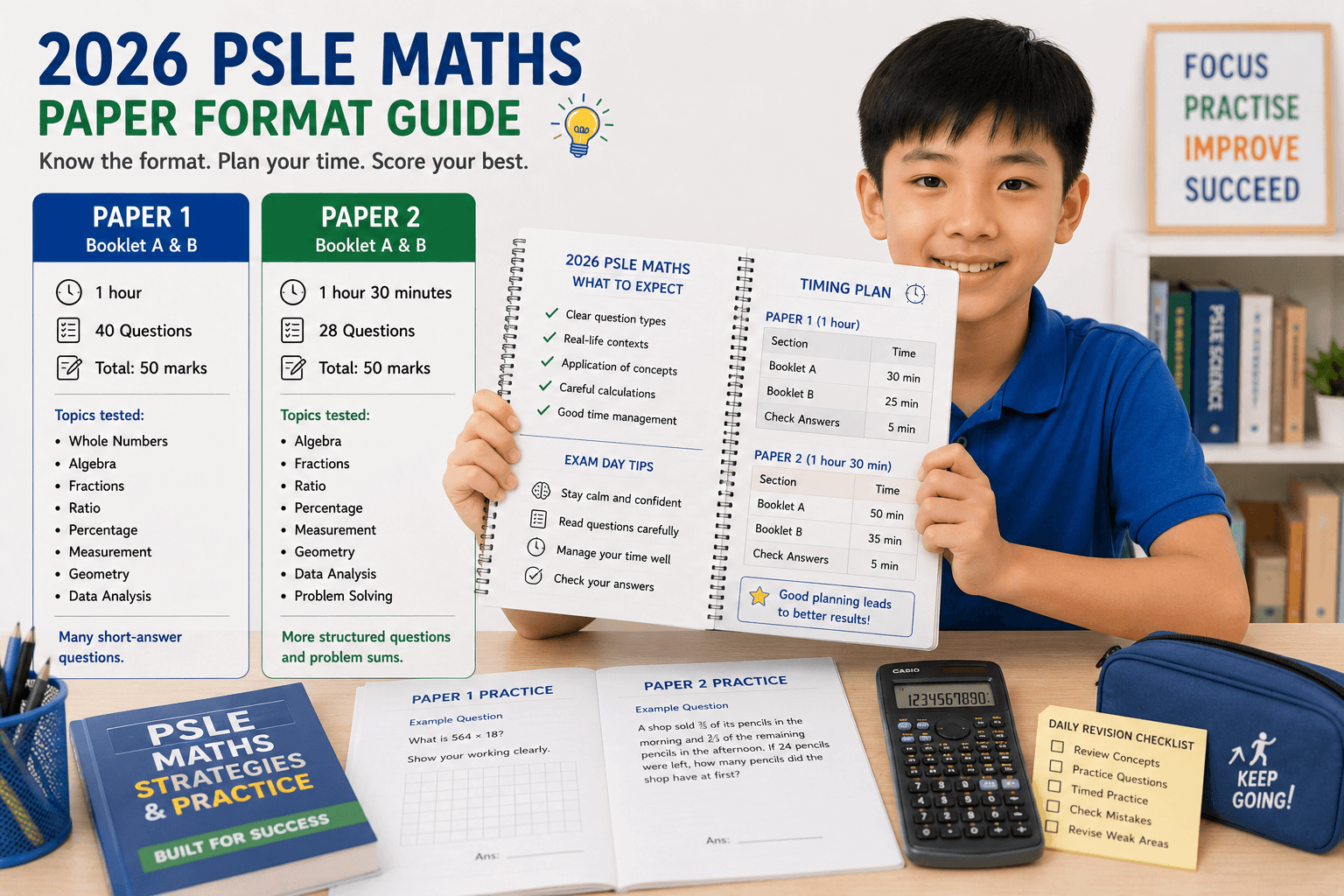
In this guide, we will explain the 2026 PSLE Maths paper format, what changed compared with the previous format, and how students can prepare smartly for Paper 1 and Paper 2.
What Is the 2026 PSLE Maths Format?
The 2026 PSLE Mathematics examination consists of two written papers across three booklets. Paper 1 has two booklets: Booklet A and Booklet B. Paper 2 has one booklet.
Paper 1 is a non-calculator paper, while Paper 2 allows the use of a calculator. Both papers are scheduled on the same day, with a break between the two papers.
2026 PSLE Maths Format at a Glance
- Paper 1 Booklet A: Multiple-choice questions
- Paper 1 Booklet B: Short-answer questions
- Paper 2: Short-answer and structured or long-answer questions
- Paper 1: Calculator not allowed
- Paper 2: Calculator allowed
- Total marks: 100 marks
This means students must prepare for both speed and accuracy in Paper 1, as well as reasoning, working steps, and problem-solving in Paper 2.
2026 PSLE Maths Paper 1 Format
Paper 1 is 1 hour 10 minutes long and consists of Booklet A and Booklet B. The use of calculators is not allowed in Paper 1, so students must be confident with mental calculation, number sense, fractions, decimals, percentages, and basic operations.
1
Booklet A
10 multiple-choice questions worth 1 mark each.
2
Booklet A
8 multiple-choice questions worth 2 marks each.
3
Booklet B
12 short-answer questions worth 2 marks each.
4
Total
Paper 1 is worth 50 marks in total.
Paper 1 now carries half of the total marks. This makes non-calculator accuracy very important. Students cannot depend on the calculator to rescue careless arithmetic errors in this section.
2026 PSLE Maths Paper 2 Format
Paper 2 is 1 hour 20 minutes long and allows the use of a calculator. However, students should not think of Paper 2 as “easier” just because a calculator is allowed. Paper 2 usually requires clearer reasoning, stronger problem-solving strategies, and proper working steps.
Paper 2 Question Structure
- 5 short-answer questions worth 2 marks each
- 10 structured or long-answer questions
- Structured or long-answer questions are worth 3, 4, or 5 marks each
- Paper 2 is worth 50 marks in total
- Students must show clear method of solution
- Calculator use is allowed
Paper 2 rewards students who can explain their thinking clearly. A correct final answer is important, but students must also show working steps properly, especially for structured and long-answer questions.
What Changed from the Previous PSLE Maths Format?
The biggest change is the mark balance between Paper 1 and Paper 2. Previously, Paper 1 was worth 45 marks and Paper 2 was worth 55 marks. Under the 2026 PSLE maths format, Paper 1 is worth 50 marks and Paper 2 is worth 50 marks.
This makes Paper 1 more important than before. Students can no longer treat Paper 1 as the “lighter” paper. Strong non-calculator skills, careful reading, and fast checking habits will matter even more.
Previous Format
Paper 1: 45 marks
Paper 2: 55 marks
Total: 100 marks
2026 Format
Paper 1: 50 marks
Paper 2: 50 marks
Total: 100 marks
Another important change is that Paper 1 Booklet B now contains 12 short-answer questions worth 2 marks each. This places more emphasis on 2-mark accuracy and method, rather than very short 1-mark short-answer questions.
Why the 2026 PSLE Maths Format Matters
The revised format affects how students should revise. In the past, some students focused heavily on Paper 2 because it carried more marks. In 2026, both papers carry equal weight, so students need a balanced revision plan.
Paper 1 requires speed, accuracy, and confidence without a calculator. Paper 2 requires application, reasoning, and structured working. A student who is strong in only one paper may struggle to maximise the total score.
Students Should Now Focus On:
- Non-calculator accuracy for Paper 1
- Fast and careful multiple-choice strategies
- Short-answer questions with clear methods
- Structured working for Paper 2
- Problem-solving strategies and heuristics
- Time management across both papers
How to Prepare for Paper 1
To prepare for Paper 1, students should practise without using a calculator. This helps them strengthen mental arithmetic, estimation, fractions, decimals, percentage conversions, and number sense.
Students should also practise multiple-choice elimination. Some MCQ options are designed to catch common mistakes. Instead of choosing the first answer that looks right, students should check whether the answer is reasonable.
Paper 1 Preparation Tips
- Practise non-calculator arithmetic daily
- Review fractions, decimals, and percentages
- Use estimation to check answers
- Underline key words in each question
- Eliminate clearly wrong MCQ options
- Leave time to check careless mistakes
Since Paper 1 is worth 50 marks, careless mistakes in this section can have a serious impact on the final AL score.
How to Prepare for Paper 2
Paper 2 requires students to show clear reasoning and organised working. Even with a calculator, students must know what to calculate, which method to use, and how to present each step.
For structured and long-answer questions, students should avoid jumping straight into calculation. They should first identify the topic, relationship, and strategy. For example, ratio questions may require units and parts, while change questions may require before-change-after thinking.
Paper 2 Preparation Tips
- Show working clearly for every step
- Practise model drawing and comparison methods
- Use the calculator carefully, not blindly
- Check units before writing final answers
- Review long-answer questions after practice
- Build stamina for multi-step problem sums
Paper 2 is where strong problem-solving habits matter. Students should practise explaining their thinking, not just getting the answer.
Common Mistakes Students Should Avoid
A revised format can make students nervous, especially if they are used to older practice papers. The key is to revise according to the current format and understand where marks are likely to be lost.
1
Ignoring Paper 1
Paper 1 now carries 50 marks, so students must train seriously for non-calculator accuracy.
2
Overusing Calculator
Calculator use is only allowed in Paper 2. Students still need strong mental calculation skills.
3
Weak Working
For Paper 2, unclear working can cost method marks even when the student understands the idea.
4
No Timing Plan
Students should practise completing each paper within the official duration, with time left to check.
How Parents Can Help Their Child Prepare
Parents do not need to teach every PSLE Maths topic. However, they can help their child prepare by creating a consistent revision routine and making sure practice matches the 2026 PSLE maths format.
Instead of asking children to complete random papers, parents can alternate between Paper 1 non-calculator drills and Paper 2 structured problem-solving practice. This keeps revision balanced and reduces last-minute panic.
Parents can also encourage children to keep a mistake journal. Each mistake should be recorded by topic, error type, and correction method. Over time, students will notice whether their main issue is concept weakness, careless mistakes, poor working, or time management.
How MasterMaths Supports PSLE Maths Preparation
At MasterMaths PSLE Maths Tuition Singapore, students receive structured guidance for PSLE Maths concepts, problem sums, and exam preparation. Lessons are designed to help students strengthen foundations, practise key question types, and build confidence for both Paper 1 and Paper 2.
Students who struggle with word problems can also benefit from focused support for PSLE problem sums, where common problem-solving methods are taught step by step.
Parents can also explore more study tips, exam preparation guides, and Maths learning articles through the MasterMaths Blog.
Final Thoughts: Prepare for the Format, Not Just the Topics
The 2026 PSLE maths format still tests strong mathematical understanding, but students must now pay closer attention to the equal weight between Paper 1 and Paper 2.
Paper 1 needs strong non-calculator accuracy, while Paper 2 needs clear reasoning and structured working. Students who prepare both papers properly will be in a better position to handle the exam calmly.
The best preparation is not last-minute drilling. It is consistent practice, careful correction, and clear understanding of how each paper is structured.
Conclusion
Understanding the 2026 PSLE maths format helps parents and students revise with better direction. The key change is that Paper 1 and Paper 2 are now both worth 50 marks, so students must prepare equally well for non-calculator accuracy and structured problem-solving.
With the right preparation plan, students can build confidence, reduce careless mistakes, and approach the revised PSLE Maths paper with a clearer strategy.
Help Your Child Prepare for the 2026 PSLE Maths Format
Let your child experience clear, structured PSLE Maths coaching before committing. Book a free trial class and see how MasterMaths can support your child’s exam preparation.